Lübbecke
The Weinberg Family
Table of contents
Lübbecke
The Weinberg Family
The Weinberg family ran a shop selling manufactured goods and fashion items on Lange Straße. It was one of the last Jewish businesses in Lübbecke to remain open until 1938, even though members of the SA had been preventing customers from entering the store since 1933. On the night of November 9, 1938, the Weinberg family’s home was vandalized; among other things, their windows were smashed and the wooden staircase leading to the upper floor was sawed off. The synagogue was set on fire. In April 1939, the family home was sold under duress—for 50% of its actual value. A large portion of the money was confiscated by the Nazi state. The justification: the Jewish population had to pay for all the damage caused during the pogrom. After Kristallnacht, Meta Weinberg lived in seclusion in Lübbecke until 1942. She then moved to Cologne, where she worked as a nurse. In January 1943, she was deported to Auschwitz and murdered in Birkenau on February 9, 1943.
Her daughter, Lore Weinberg, had to leave the school in Lübbecke after the 8th grade and transferred to a Jewish boarding school in Herrlingen/Ulm and later to Berlin. Later, she too was sent to a labor camp. In 1943, Lore Weinberg herself was deported to Auschwitz. There, she was forced to work as a typist keeping records of the dead and learned of her mother’s murder from one of the lists. In 1945, she was forced to join the death march westward to the Malchow camp. The camp was liberated by the Red Army.
After various stages of recovery, which also took her to Switzerland, she studied and earned her doctorate, eventually married, and emigrated to the United States with her husband in 1956 as Dr. Lore Shelly. In 1964, she served as a reporter at the Auschwitz trial in Frankfurt and contributed as an author to the book “Schreiberinnen des Todes” (Women Who Wrote of Death).
Lübbecke
The Weinberg Family
The Weinberg Family
Report from Birkenau, written by Lore Weinberg.
Read by Erika Müller
</poi>
The Weinberg Family
Memorial Stones
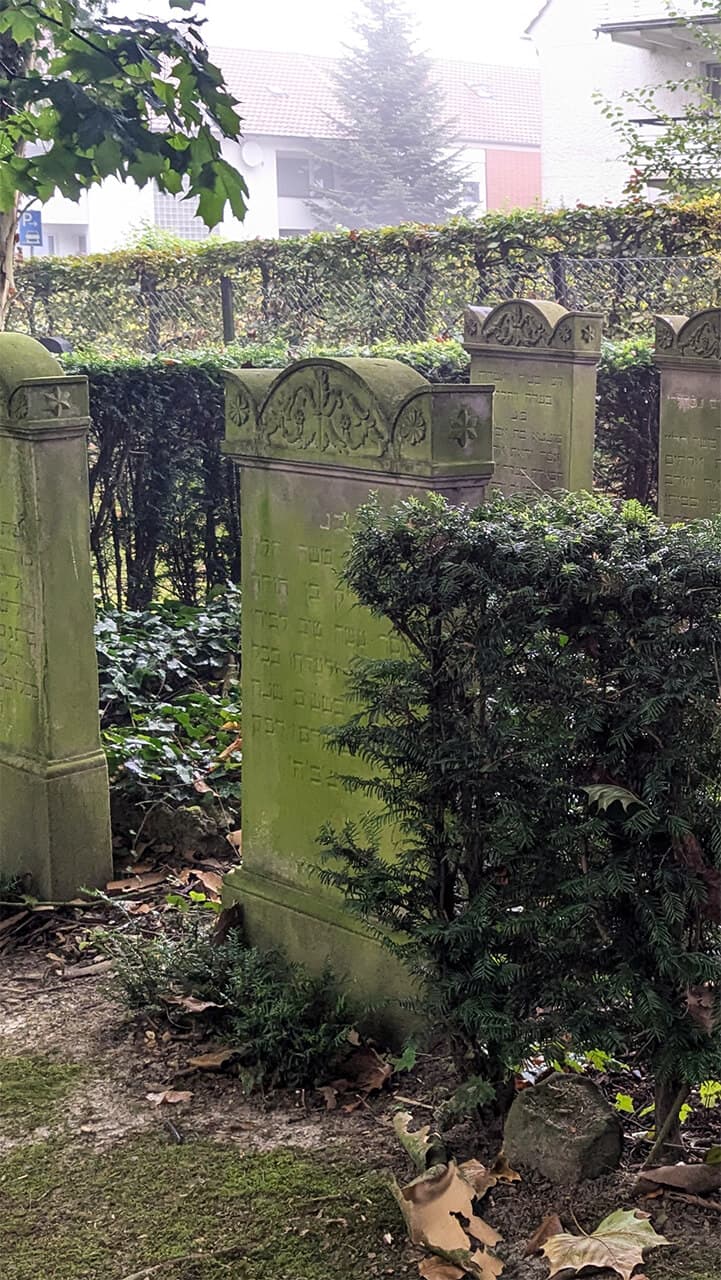
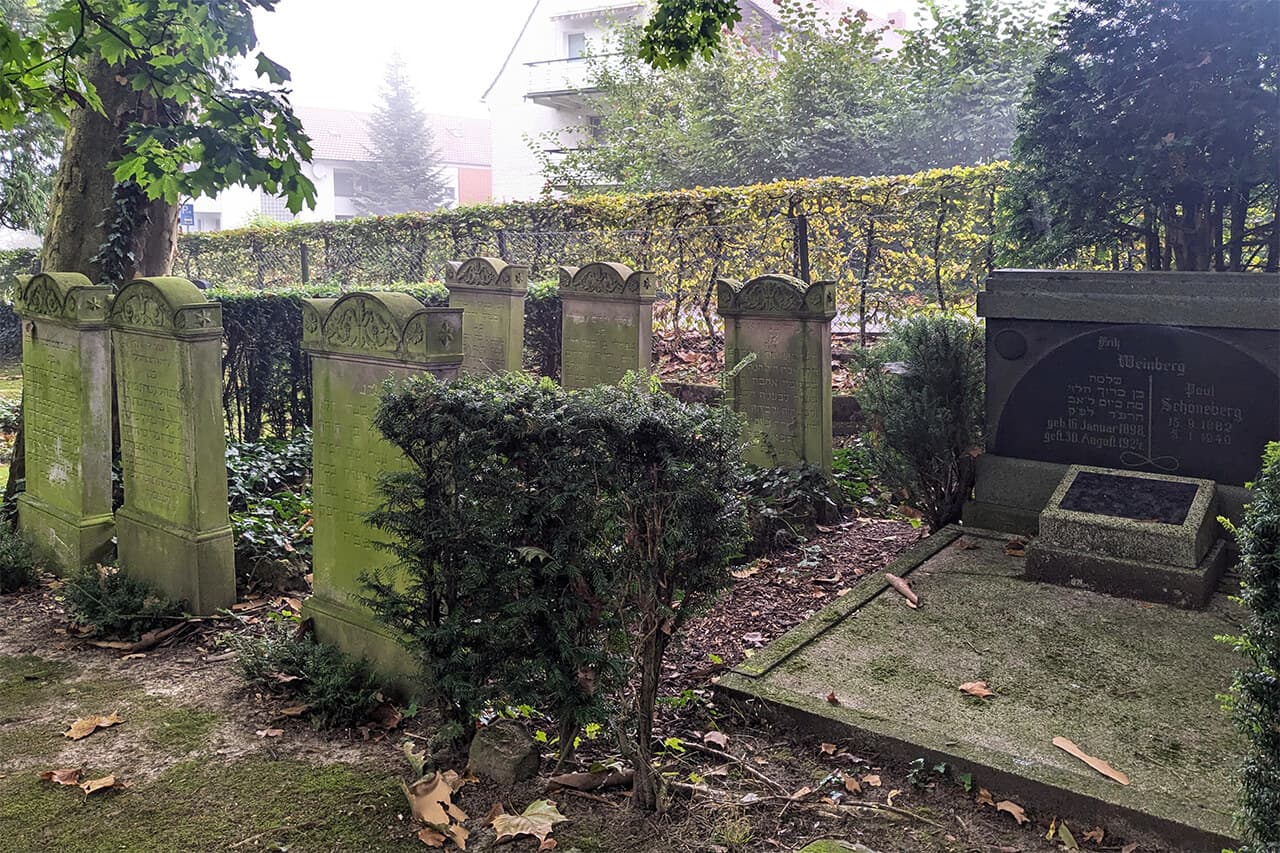
Here you will find epitaphs commemorating family members who were murdered during the Nazi era: Paul Schönberg was married to Meta Weinberg. He died shortly after Kristallnacht, during which his shop and home were destroyed. He is one of the last people to be buried here. His death was undoubtedly linked to the terror, fear, and uncertain future.
The memorial stone in front of the grave was placed there after the war and commemorates Meta Weinberg, who was murdered in the Auschwitz concentration camp. Look for the memorial inscription for Bernhardt and Grete Neustädter! They were members of the Hecht family.
On Leopold Bloch’s gravestone, his son Helmut commemorates his mother. As a young man, he was also in a concentration camp but survived. He was the only one from the community to return to Lübbecke. He is buried in the municipal cemetery next to his wife, a Christian.
Near the entrance, a memorial stone commemorates the soldier Max Löwenstein. He fell in World War I. You can recognize the memorial by a laurel wreath and the “Iron Cross,” a symbol of bravery.</poi>